
Your Small Business Seasonal Marketing Playbook: Maximize Sales All Year
Unlock your small business's potential with this seasonal marketing playbook. Learn to plan campaigns, create compelling offers, and boost sales during every peak period.
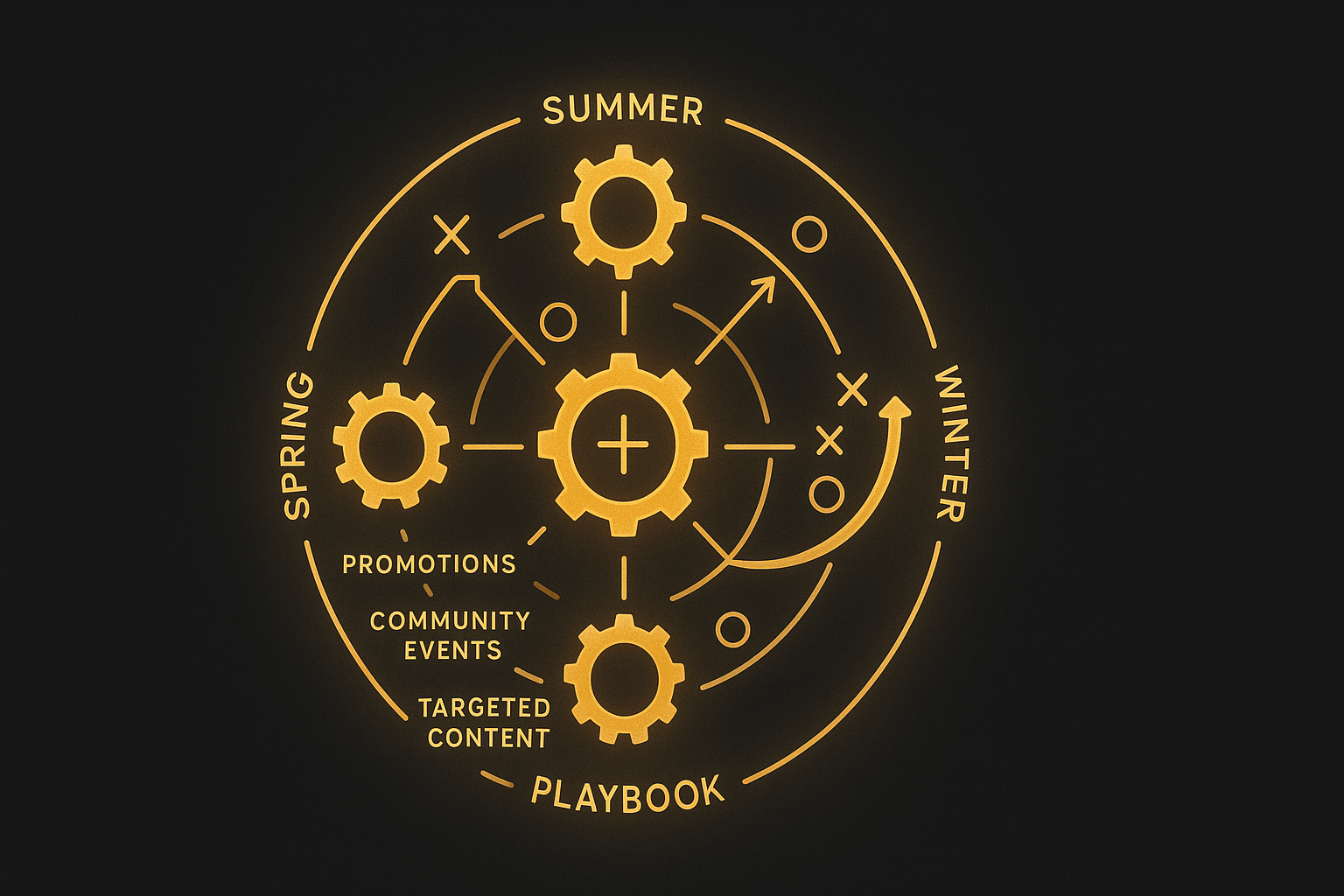
Every business has a season where the phone doesn't stop ringing — and one where it barely rings at all. The businesses that grow year over year don't get lucky during their busy season; they plan for it months in advance, and they use the slow season to set up the next wave.
A real seasonal marketing plan means you know what you're promoting every month before the year even starts — and you're building the audience for it weeks ahead of time, not the week of. Here's how to build one, using a hypothetical family-owned hardware store as our running example.
Understanding Your Business's Unique Seasonal Rhythms
Before you plan campaigns, map your actual demand curve. Don't guess — pull it from your own history.
- Look at 12-24 months of sales data (POS reports, invoices, even bank deposits) by month or week.
- Flag your top 3 peak periods and your 1-2 dead zones.
- Note what customers are actually buying in each peak — not just "we're busy in spring," but "we sell soil, seed starters, and fencing in spring."
For a hardware store, that rhythm might look like:
- Spring (March–May): gardening tools, mulch, fencing, paint
- Summer (June–August): DIY projects, grills, power tools, patio builds
- Fall (September–October): weatherproofing, gutter cleaning supplies, storage
- Winter Holidays (November–December): gifts for the DIYer, lights, generators, snow removal
Every business has this pattern, even service businesses. A tax prep office peaks Jan–April. A landscaper peaks in spring and slumps in winter. Write your version of this list down before reading further — everything else in this playbook builds on it.
Building a Year-Long Seasonal Marketing Calendar: From Concept to Content
Once you know your peaks, work backward. The rule of thumb: start marketing a peak season 4-6 weeks before it begins, so you're building demand, not just announcing a sale.
A simple way to structure it:
| Timing | Activity |
|---|---|
| 6 weeks before | Tease the theme, start building an email list or social following around it |
| 3-4 weeks before | Launch the offer/promotion, start content series |
| 1-2 weeks before | Push harder — ads, reminders, urgency (not discounts — more on that next) |
| During peak | Daily content, in-store experience, community events |
| 1 week after | Thank-you content, collect reviews/testimonials, plan next season |
Put this on an actual calendar — a spreadsheet with 12 rows, one per month, columns for theme, offer, content plan, and event. This single document becomes your entire year's marketing brief. Fill it out once in January and you'll never again be scrambling three days before a holiday.
Crafting Themed Offers and Promotions That Resonate (Beyond Discounts)
Discounting trains customers to wait for sales and erodes your margin. Seasonal marketing works better when the offer is about relevance and value, not price.
Instead of "20% off," try:
- Bundles: "Spring Garden Starter Kit" — soil, seeds, gloves, and a trowel bundled at a slightly better combined price than buying separately.
- Free expertise: "Free 15-minute fence-planning consult with any lumber purchase over $200."
- Early access: Let loyal customers/email subscribers shop a seasonal collection 3 days before it's public.
- Added value, not lower price: Free delivery on patio-building supplies during summer weekends.
- Limited-run products: A seasonal item that only exists for 6 weeks a year creates urgency without a discount.
For our hardware store: instead of "10% off mulch," they could run "Bring in a photo of your yard, get a free 10-minute landscaping sketch from our team." It costs almost nothing, showcases expertise, and gets people in the door — which is when they buy the mulch, the edging, and the tool they didn't know they needed.
Takeaway: every seasonal promotion should answer "why now, from us" — not just "why cheaper."
Multi-Channel Content Strategy: Social Media, Email, and In-Store Experience
One offer, three surfaces. Don't just post it — surround the customer with it.
- Social media: Post a mix of educational ("3 things to check before your first spring mow"), behind-the-scenes (staff prepping the seasonal display), and direct offer posts. Aim for a 3:1 ratio of helpful/entertaining to promotional.
- Email: Segment your list if you can — "gardeners," "DIYers," "past holiday shoppers." Even a simple 3-email sequence (tease → launch → last call) beats one blast.
- In-store: Match the digital theme physically. A window display, an end-cap, a chalkboard sign — anything that echoes what people saw online makes the promotion feel real and increases in-store conversion.
Content ideas by season for a hardware store:
- Spring: "5 tools every beginner gardener needs" (video), staff picks for fencing
- Summer: Time-lapse of a DIY patio build using store materials
- Fall: "Winterize your home in a weekend" checklist
- Winter: Gift guide for "the person who's impossible to shop for" (DIYers, always)
Do this today: pick your next seasonal peak and draft one piece of content for each channel — one social post, one email subject line, one in-store idea. That's your template for every future season.
Leveraging Local Events and Community Partnerships for Seasonal Buzz
Seasonal marketing doesn't have to live only on a screen. Local partnerships multiply your reach for free or near-free.
- Co-host an event: A spring "seed swap" in your parking lot with a local garden club.
- Sponsor something visible: A local Little League team's summer season, with your logo on jerseys and a mention that you supply the field's equipment.
- Cross-promote with adjacent businesses: Partner with a local nursery — they refer customers needing tools, you refer customers needing plants.
- Show up at community events: A booth at a fall festival with a simple demo (like a tool-sharpening station) builds goodwill and collects email sign-ups.
These moves matter most in your slow seasons — they keep your name circulating even when your core offer isn't in high demand. A hardware store's slow month might be January; hosting a free "repair your holiday-broken stuff" clinic keeps foot traffic alive.
Measuring Seasonal Campaign Success and Optimizing for Future Growth
You can't improve next year's spring campaign if you didn't track this year's. Keep it simple — you need four numbers per campaign:
- Reach: how many people saw the content/ads
- Engagement or traffic: clicks, comments, store visits
- Conversion: sales tied to the promotion (use a specific code, bundle name, or simple "ask at checkout" tracking)
- Cost: what you spent on ads, materials, event sponsorship
After each season, write a one-paragraph debrief while it's fresh: what worked, what flopped, what you'd change. Store it in the same calendar document from earlier, dated by year. After 2-3 years, you'll have your own internal playbook — better than any generic guide, because it's based on your actual customers.
Illustrative example (not a real result, just to show the math): say a $150 social boost and a $50 in-store display for a "Fall Weatherproofing Weekend" generates 40 extra transactions averaging $35 each — that's $1,400 in sales against $200 spent. Track that ratio every season and you'll quickly see which themes deserve more budget next year and which should be retired.
Hardware Haven's Year, at a Glance
To see how all these pieces connect across twelve months rather than in isolation, picture a hypothetical: Hardware Haven, a fictional family-run store, sequences its year as a repair clinic during the January slump, a garden bundle and seed swap through spring, weekly DIY time-lapse content each summer, a winterize checklist campaign each fall, and a DIYer gift guide with a sponsored tree-lighting each winter.
No single "% off everything" sale appears anywhere on that calendar. Each season carries its own theme, its own offer, and its own community touchpoint — the cumulative effect of which is a brand identity as the local expert for whatever the season demands, not a discount bin customers wait around for.
How to do this with Castopia
All of this — a calendar, content for three channels, event promotion, and tracking — is exactly the kind of recurring, multi-step work Castopia is built to carry.
Once Castopia scans your website and builds your brand profile, you can chat "make me a spring garden bundle ad" or "create a fall weatherproofing checklist post" and get on-brand content variants instead of starting from a blank page each season. The daily creator loop preps a short-video script each day, so committing to something like weekly DIY time-lapse content doesn't mean writing scripts yourself at 11pm. Scheduling lets you build the whole seasonal calendar in one sitting and auto-publish it as each date arrives. And when you put budget behind a push like "Winterize Your Home," the AI ad agent monitors performance and scales what's actually converting, so spend flows toward what's working each season instead of being split evenly and hoped for.
Your next step
Open a blank spreadsheet right now and write down your business's three busiest months and your one slowest month — based on real data if you have it, your best gut sense if you don't. That four-line list is the seed of your entire year's marketing calendar.
Don't just learn marketing — let Castopia do it with you
Castopia learns your business, then turns what you read here into posts and campaigns in your voice — you stay the face, it does the busywork.
Start free with CastopiaKeep learning

Small Business Brand Storytelling: A Playbook to Cultivate Your Own Following
Every bookstore sells the same books. The one three blocks from you that's always got a line for story time and a newsletter people actually open, isn't selling books. It's selling a story you want to be part of.
8 min read
Grand Opening Marketing Playbook for Small Business: How AI Ignited a Shop's First Month
A grand opening is the only day you get to make a first impression on an entire neighborhood at once. Most small-business owners spend months perfecting the product and about ninety minutes thinking about the marketing. Let's fix that with a full playbook, walked through step by step using a hypothetical example.
7 min read
The Small Business Social Media Playbook: How a Coffee Shop Uses AI to Fill Seats & Build Loyalty
Discover how a local coffee shop transformed its social media presence into a foot-traffic magnet using AI. This playbook outlines a sustainable, AI-powered strategy for small businesses to build loyalty, drive engagement, and fill seats without needing an in-house marketing team.
6 min read